Fabric QC Before Cutting: 5 Things You Must Check Before Production Starts
Fabric arrives from your supplier. Delivery note matches. Weight checks out. Color looks fine.

Stack it in the warehouse, start cutting tomorrow.
It feels efficient. And that's exactly how most garment operations work — especially those who've been buying from the same supplier for years. That trust is understandable. But it's precisely that habit where most production problems begin.
The fabric you receive is the fabric as described on the delivery note. That's not necessarily the fabric you need on the cutting table.
The gap can be small — GSM off by 10, fabric width narrower by 2 cm, one roll from a different dye lot. Small on paper. Significant on the production floor.
Fabric QC before cutting isn't about distrusting your supplier. It's about making sure you have full control of your process before production costs start running.
Why Fabric QC Gets Skipped — and What It Costs
It's not laziness. Most garment operations simply don't know what to check — so nothing gets checked at all.
The problem is that once fabric has been cut, your options shrink dramatically. You can't return fabric that's already been cut into panels. You can't file a valid claim with your supplier if you have no documentation of the fabric's condition before production began.
The cost of a mistake after cutting is always higher than the cost of QC before cutting:
Cutting with incorrect measurements because fabric width is inconsistent → material waste
Sewing pieces from two different dye lots → uneven finished products → customer complaints
Shipping garments made from damp fabric that shrinks unevenly → size changes after washing → returns
All of this is preventable in 15–20 minutes before production starts.
5 Things to Check Before Fabric Reaches the Cutting Table
1. GSM Verification

GSM — grams per square meter — is the fabric weight that determines thickness, drape, and the feel of your finished product. It's the first thing your customer notices when they hold your garment.
Combed 30s at 160 GSM and 145 GSM look nearly identical before sewing. But the difference is immediately apparent in the customer's hands.
Simple check without specialized equipment:
Cut a 50 cm × 50 cm sample from the corner of a roll.
Weigh the sample — a kitchen scale works fine.
Multiply the result by 4. That's your GSM estimate.
Example: a 50×50 cm swatch weighs 38 grams → 38 × 4 = 152 GSM.
Compare against the specification on your delivery note. A tolerance of ±5 GSM is generally acceptable. Beyond that, confirm with your supplier before proceeding.
2. Color Consistency and Dye Lot

This was covered in detail in the previous article, but it's too important to skip in any QC checklist.
Take a small swatch from at least 3 different rolls in the same delivery. Hold them side by side under natural daylight — not fluorescent warehouse lighting, which can mask color differences.
If you see any visible color variation, check the lot codes on each roll's label. Different lots in the same production run is a problem waiting to surface.
Read more: [Fabric Dye Lot Inconsistency Causes Returns — Here's Why It Happens and How to Prevent It]
3. Fabric Width

Fabric width determines how many pattern pieces you can lay out per meter — and directly affects your material efficiency and production cost.
Knit fabrics are typically sold tubular (in cylinder form) or as open width. Width can vary between rolls, and sometimes even within a single roll.
How to check:
Measure the width at three different points: the start of the roll, the middle, and the end.
Record and compare all three measurements.
A difference of more than 2 cm between points needs to be confirmed with your supplier — because a pattern built for a specific width will be off if the actual width differs.
It seems minor, but a 3 cm width difference can meaningfully change your yield per meter at production scale.
4. Physical Defects: Holes, Stains, Broken Yarns
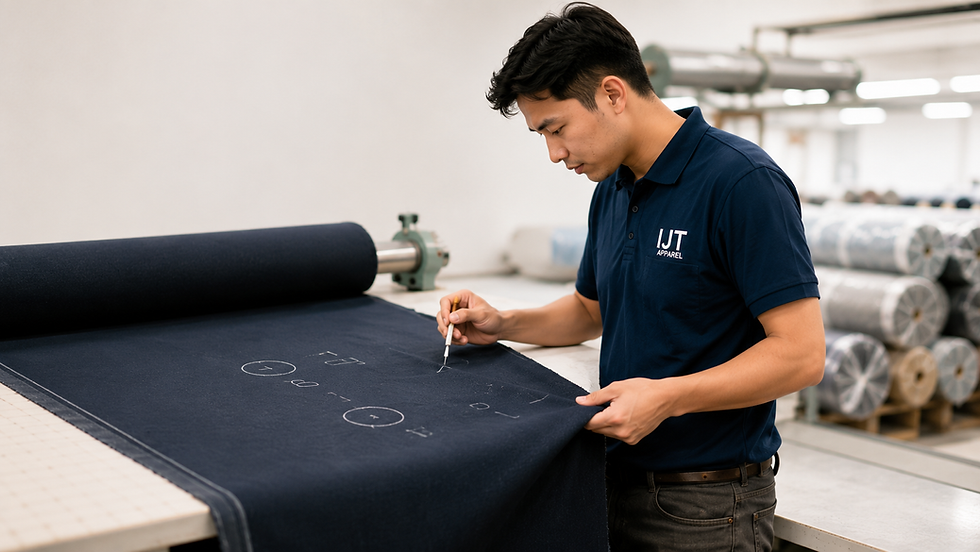
Physical defects in knit fabric come in a few forms: small holes from broken yarns during the knitting process, machine oil stains, or horizontal streaks (barre) from inconsistent knitting tension.
Not every defect renders an entire roll unusable — but you need to know where the defects are before cutting starts, not after.
How to check:
Unroll at least 2–3 meters from the end of each roll and inspect under adequate lighting.
Mark any defects with chalk or pins — the cutting team can work around those areas during pattern layout.
Too many defects, or defects that are too large → document and report to your supplier before proceeding.
Note: defects in the first 1–2 meters of a roll are fairly common and usually within acceptable tolerance. What to watch for are defects appearing in the middle of a roll.
5. Fabric Condition: Moisture and Signs of Poor Storage

This is the check that most often gets missed entirely.
Fabric stored in humid conditions or exposed to extreme temperature changes can shrink unevenly after washing. That means two garments cut from the same roll with the same pattern can end up at different finished sizes — simply because the fabric wasn't properly conditioned before production.
What to check:
Feel the fabric surface — does it feel damp or unusually cold?
Smell it — a musty or mildew odor is a sign of storage problems.
Check the plastic wrapping — torn, wet, or showing signs of mold?
Inspect the outer packaging — water stains or moisture damage on boxes or bags?
Fabric that shows signs of moisture should be aired out in a dry room before going into production — minimum 24 hours, ideally 48.
How Long Does This QC Actually Take?

Done systematically, all five checks can be completed in 15–20 minutes per delivery.
Compare that to the time required to handle a single return: negotiating with the customer, re-producing the order, re-shipping, and then rebuilding the trust that was damaged in the process.
Fabric QC before cutting isn't a time cost. It's a 20-minute investment that protects everything that comes after it.
What to Do If Fabric Fails QC

Don't reject outright, and don't accept without documentation.
The right approach:
Document the findings. Photograph the fabric condition, record lot numbers, roll numbers, and the nature of the defect. This is the evidence you need for a valid claim.
Contact your supplier with specific data. Not a verbal complaint — a written report with photos and details. "Rolls 3 and 7 are different lots, color difference visible under natural light" is actionable. "The fabric looks different" is not.
Wait for clarification before continuing. Don't cut while waiting for confirmation. Once fabric is cut, a material claim is nearly impossible to process.
A professional supplier will take a report like this seriously — because they have just as much interest in protecting their reputation for consistent quality.
One Perspective Worth Shifting

Fabric QC before cutting is not a sign of distrust toward your supplier.
In fact, it's the opposite: a good supplier welcomes buyers who run QC, because it means standards are clearly defined on both sides. No room for different interpretations. If there's a problem, it gets caught and resolved before losses compound.
A healthy supplier–buyer relationship isn't one built on blind trust. It's one where both sides hold the same standard together.
The Bottom Line

These five checks don't require expensive equipment, specialized skills, or significant time. They require a habit — and that habit starts with the next delivery.
Fabric that passes all five checks is fabric that's ready to cut. Fabric that hasn't been checked is a variable you haven't controlled yet.
And in production, the fewer uncontrolled variables, the more likely the outcome matches what you planned.
Your supplier should be helping you pass QC — not giving you reasons to keep repeating it. If you want to know the QC standards IJT applies before fabric ships, ask our team directly.
Contact our 24hr CS at WA 0812 9090 2360 or contact our store admin at office hours (Monday - Friday 09.00 - 17.00 and Saturday 09.00 - 17.00, Sunday off) at WA 0812 1234 2360
Related articles:
← Fabric Dye Lot Inconsistency Causes Returns — Here's Why It Happens and How to Prevent It
→ How Much Fabric Do You Need Per Dozen T-Shirts? The Real Production Formula


Comments